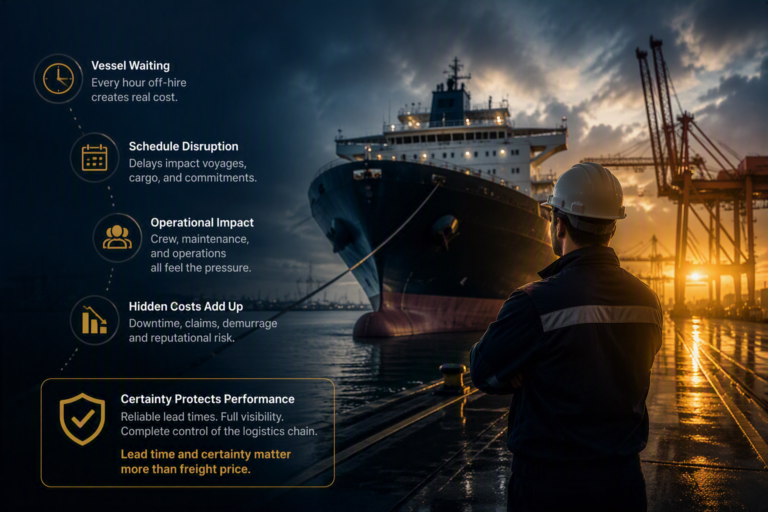
The Hidden Cost of Vessel Downtime
A critical spare part has failed. The vessel is waiting. Operations are disrupted.
At that moment, freight cost is rarely the biggest concern.
What matters is certainty.
Every hour a vessel sits idle can create costs that far exceed the difference between standard freight and a time-critical logistics solution. Yet many procurement decisions are still driven by transport price alone.
The hidden cost of vessel downtime is often overlooked until it becomes visible on an operational report, a charter party claim, a missed schedule, or an unhappy customer.
For shipowners, technical superintendents and procurement teams, understanding the true cost of downtime is essential.
Downtime Starts Long Before the Vessel Stops
Most downtime incidents do not begin with equipment failure.
They begin weeks earlier.
A spare part is ordered. Lead times appear acceptable. The transport option looks competitive. Everything seems under control.
Then reality intervenes.
A supplier delays dispatch. Documentation is incomplete. Customs clearance takes longer than expected. A missed connection creates another day’s delay. Suddenly, the vessel’s maintenance schedule is under pressure.
The issue is rarely a single event. More often, it is the accumulation of small delays throughout the supply chain.
This is why experienced fleet operators look beyond freight rates and focus on reliability, visibility and execution.
The Real Cost Is Not the Freight
A procurement team may save money by selecting the lowest transport quote.
However, if that decision increases delivery uncertainty, the financial impact can quickly outweigh any initial savings.
Consider what is really at stake:
- Vessel idle time
- Delayed departures
- Rescheduled dry dock activities
- Additional port costs
- Engineering delays
- Crew overtime
- Operational disruption across the fleet
While transport costs appear clearly on an invoice, operational losses often emerge elsewhere in the organisation.
As a result, the most expensive logistics decision can sometimes be the cheapest freight option.
Lead Time Creates Operational Control
In marine logistics, speed matters.
But certainty matters even more.
A spare part that arrives exactly when planned allows technical teams to coordinate maintenance efficiently. Port calls can be optimised. Engineers can prepare resources. Vessel schedules remain intact.
Predictable lead times create control.
Unpredictable lead times create risk.
This is particularly important for critical components, where a delayed delivery can affect the safe and efficient operation of the vessel.
The goal is not simply to transport cargo from one location to another.
The goal is to ensure the right part arrives at the right port at the right time with the right documentation.
Every Step in the Chain Matters
Marine spare-parts logistics is far more complex than moving a parcel.
A successful delivery often depends on multiple stages working together without interruption:
Supplier Pickup
The process begins with immediate collection from the manufacturer or supplier. Delays at origin can affect the entire timeline.
Time-Critical Transport
Whether by air freight, dedicated courier, hand-carry service or multimodal transport, shipment selection must be aligned with the vessel schedule.
Customs Clearance
Incorrect declarations or missing documentation can create unexpected delays. Fast and accurate customs handling is essential.
Port Coordination
Delivery windows change frequently. Vessel schedules can shift without notice. Real-time coordination becomes critical.
Final Vessel Delivery
The last mile is often the most challenging stage. Access requirements, security regulations and operational restrictions must all be managed carefully.
The weakest link determines the outcome.
That is why leading shipowners increasingly seek logistics partners capable of controlling the entire chain rather than individual transport segments.
Why Visibility Reduces Risk
One of the biggest frustrations for technical and procurement teams is uncertainty.
A shipment may be moving, but nobody knows precisely where it is or whether it will meet the required deadline.
Lack of visibility creates operational stress.
Early identification of potential disruptions allows corrective action before a delay impacts the vessel.
If a flight is missed, an alternative routing can be arranged.
If customs documentation requires amendment, intervention can happen immediately.
If the vessel changes port rotation, delivery plans can be adjusted.
Visibility transforms reactive logistics into proactive logistics.
And proactive logistics prevents downtime.
The Value of Taking Ownership
Marine supply chains have become increasingly complex.
Suppliers, freight carriers, customs authorities, agents, terminals and vessel operators all play a role.
The challenge is not simply moving cargo.
The challenge is managing every stakeholder involved.
This is where integrated logistics management provides significant value.
Rather than coordinating multiple service providers independently, shipowners can benefit from a single logistics partner overseeing every stage of the process.
One point of contact.
One operational plan.
One accountable partner.
When responsibility is fragmented, problems often fall between organisations. When responsibility is centralised, issues are identified and resolved faster.
Downtime Prevention Is a Strategic Investment
Reducing vessel downtime is not about spending more.
It is about making better-informed decisions.
The lowest freight cost may deliver the highest operational risk.
Conversely, investing in reliable execution, predictable lead times and complete supply-chain visibility can protect vessel schedules, reduce disruption and support fleet performance.
For technical superintendents and procurement professionals, the question should not be:
“What is the cheapest transport option?”
The question should be:
“Which solution gives us the highest probability of delivering the part on time?”
Because when a vessel is waiting, certainty becomes the most valuable commodity in the supply chain.
Every hour counts.
There is no room for delay or uncertainty.
At Legero International Group, we manage marine and offshore spare-parts logistics from supplier pickup to vessel delivery. Worldwide. Across more than 2,000 ports.
Our focus is simple: keeping vessels moving by taking control of the logistics chain before small delays become costly disruptions.
Any Part. Anywhere. Anytime.