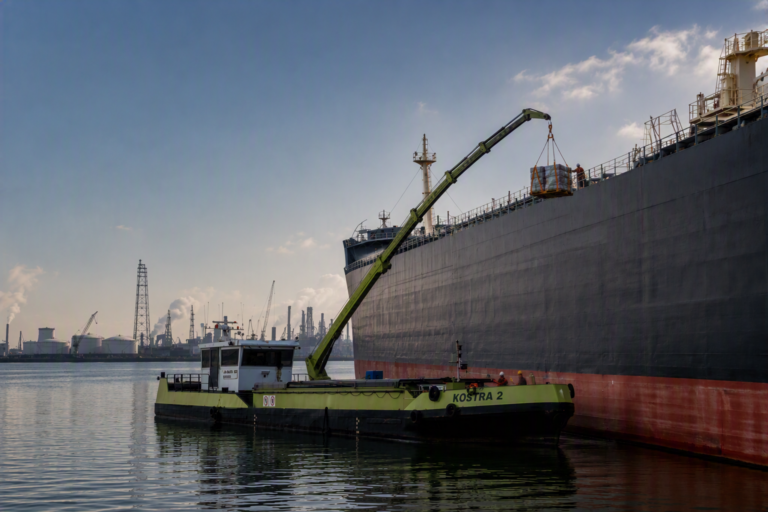
Delivery by Crane barge in the Port of Rotterdam
In the Port of Rotterdam, many vessels cannot receive ship spares directly from the quay. Terminal restrictions, vessel positioning, operational activities and safety requirements often demand a different approach. In these situations, crane barge operations provide a practical and reliable solution.
One of the most effective methods is the use of our crane barges for ship spares, stores and provision delivery directly to vessels within the Rotterdam port area.
This guide explains how ship spares delivery by cranebarge works, when it is required and why it remains an important part of marine logistics operations in Rotterdam.
Why Ship Spares Need Special Delivery Solutions
Marine vessels operate on tight schedules.
When a critical component needs replacement, waiting until the next port call is often not an option. Technical superintendents and fleet managers therefore require logistics partners capable of moving cargo from supplier to vessel with complete control and visibility.
However, delivering cargo onboard is not always straightforward.
Challenges may include:
- Limited quay access
- Terminal restrictions
- Security regulations
- Vessel draft limitations
- Cargo weight and dimensions
- Restricted working areas
When direct delivery is impossible, a cranebarge provides safe access from the waterside.
What Is a Cranebarge?
A cranebarge is a specialised floating platform equipped with lifting equipment designed to transfer cargo directly between the barge and a vessel.
Unlike conventional transport vehicles, a cranebarge can position itself safely alongside a vessel and perform controlled lifting operations while remaining on the water.
This provides significant advantages when handling:
- Ship spare parts
- Palletised cargo
- Engine components
- Technical equipment
- Maintenance materials
- Operational supplies
For many vessel deliveries in Rotterdam, a cranebarge forms the crucial final link in the logistics chain.
The Role of Legero Kostra Ports Services in Rotterdam
The Port of Rotterdam is Europe’s largest seaport and one of the world’s most active maritime hubs.
Vessels regularly call at terminals, refineries, offshore facilities and specialised locations where conventional deliveries may be difficult or restricted.
The Kostra cranebarges are frequently used to support vessel supply operations within these environments.
Its ability to safely transfer cargo directly from waterside position to vessel deck allows technical deliveries to continue without unnecessary disruption to port operations.
For shipowners and vessel managers, this means critical spare parts can reach the vessel when alternative delivery methods may not be practical.
How the Process Works
Successful ship spares delivery begins long before the cranebarge arrives alongside the vessel.
Every stage requires planning, coordination and accurate execution.
1. Supplier Collection
The process begins with collection of the cargo from the supplier, manufacturer or warehouse location.
Cargo details are verified to ensure documentation, dimensions and handling requirements are correct before transportation starts.
2. Transport to Rotterdam
Depending on the shipment origin and urgency, cargo may move via road freight, air freight, courier services or dedicated time-critical transport solutions.
Throughout the journey, shipment status is monitored to avoid surprises later in the process.
3. Customs Clearance
International ship spares often require customs formalities before entering the port supply chain.
Accurate customs documentation helps prevent delays and allows cargo to continue moving efficiently towards the vessel.
4. Port Coordination
Before delivery can take place, operational details must be confirmed.
These typically include:
- Vessel location
- Terminal access conditions
- Delivery window
- Safety requirements
- Cargo handling instructions
- Operational restrictions
This stage is essential for creating a safe and efficient delivery operation.
5. Cranebarge Loading
Once preparations are complete, cargo is transferred onto the cranebarge.
Each item is secured according to handling requirements before departure to the vessel location.
6. Vessel Delivery
The cranebarge positions alongside the vessel under controlled conditions.
Using onboard lifting equipment, cargo is safely transferred directly onto the vessel deck where it can be received by the crew or technical personnel.
Proof of delivery is then provided, creating complete visibility and accountability.
Why Timing Matters
A delayed spare part can have consequences throughout the vessel’s operation.
Maintenance schedules may be affected. Repairs may be postponed. Operational flexibility may be reduced.
The cost of waiting often exceeds the cost of the logistics itself.
That is why proactive planning remains critical.
Experienced marine logistics providers continuously monitor vessel schedules, weather conditions, terminal requirements and transport progress. Potential delays are identified early and alternative solutions can be arranged before the situation becomes a problem.
This approach reduces risk and helps maintain operational continuity.
Why Rotterdam Remains a Key Ship Spares Hub
Rotterdam serves vessels operating across Europe and around the world.
The port’s strategic location, transport connectivity and maritime infrastructure make it a natural hub for ship spares logistics.
Shipowners benefit from:
- Global transport connections
- Extensive warehousing capabilities
- Customs expertise
- Marine service providers
- Port support infrastructure
- Flexible delivery options
When combined with specialised onboard delivery solutions such as cranebarge operations, Rotterdam offers a strong platform for supporting vessel maintenance and operational requirements.
Choosing the Right Logistics Partner
Not every freight forwarder understands marine logistics.
Ship spares deliveries require more than transportation alone. They require coordination between suppliers, carriers, customs authorities, vessel agents, port operators and ship crews.
The right logistics partner should provide:
- Marine logistics expertise
- Time-critical shipment management
- Customs clearance support
- Port coordination
- Offshore and vessel delivery experience
- End-to-end visibility
Most importantly, they should remain in control when circumstances change.
Because in shipping, they often do.
Legero International Group
At Legero International Group, we understand what happens when a vessel is waiting for a critical delivery.
We coordinate every step of the process. From supplier pickup and transport arrangements to customs clearance, cranebarge coordination and final vessel handover.
Our objective is simple.
Keep vessels moving.
Whether the shipment involves routine maintenance parts or urgent operational requirements, we provide practical solutions designed around the realities of marine and offshore logistics.
Because downtime is never part of the plan.
Any Part. Anywhere. Anytime.