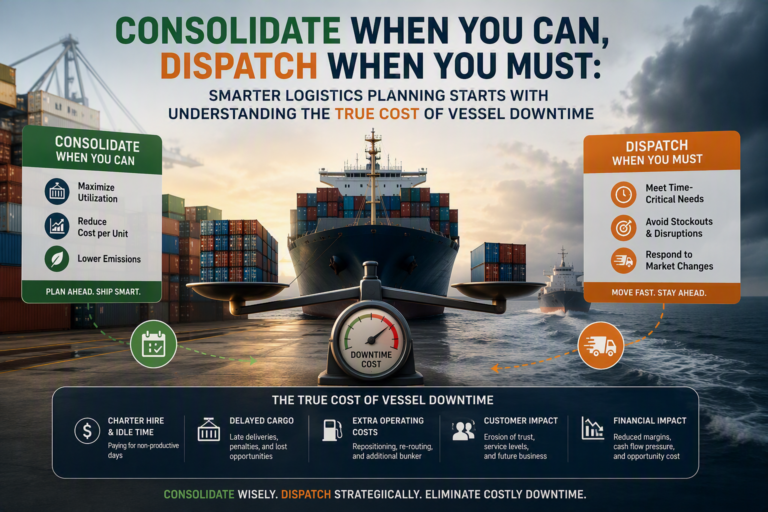
Consolidation vs. Direct Dispatch
Consolidate when you can, dispatch when you must: smarter logistics planning starts with understanding the true cost of vessel downtime.
A vessel is waiting for critical spare parts. The supplier is ready. The clock is ticking.
The first question most procurement teams ask is simple: should we dispatch immediately or consolidate shipments first?
The answer is rarely straightforward.
Every fleet operates under constant pressure to control costs while maintaining vessel readiness. Freight rates, customs procedures, last-mile delivery challenges and unpredictable sailing schedules all influence the final outcome. Focusing on transport cost alone can lead to expensive mistakes.
The real objective is not to minimise the cost of a shipment. It is to minimise the total logistics cost across the fleet.
Understanding when to consolidate cargo and when to dispatch immediately can have a significant impact on operational efficiency, inventory management and vessel uptime.
What Is Consolidation in Marine Logistics?
Consolidation involves collecting multiple spare parts, consumables or technical stores from different suppliers and combining them into a single shipment before delivery to the vessel.
Rather than moving each item individually, cargo is gathered at a logistics hub or warehouse, checked, documented and prepared as one coordinated shipment.
The process typically follows these steps:
- Supplier collection
- Receipt at consolidation warehouse
- Cargo inspection and documentation
- Export preparation
- International transport
- Customs clearance
- Vessel delivery
For fleet operators managing multiple purchases from different vendors, consolidation can reduce transportation costs and simplify administration.
The result is greater control over the supply chain and fewer separate shipments moving through the network.
What Is Direct Dispatch?
Direct dispatch takes a different approach.
As soon as the spare part is ready, it is collected and transported directly to the vessel or destination port without waiting for other cargo.
This approach is frequently used for:
- Critical engine components
- Safety equipment
- Navigation systems
- Electronic control units
- Emergency repairs
- AOG and vessel-down situations
The process is designed for speed.
Supplier pickup is arranged immediately. Transport is booked on the fastest available route. Customs procedures are managed as rapidly as possible. Delivery to the vessel becomes the primary objective.
When downtime costs exceed transport costs, direct dispatch is often the preferred option.
The Hidden Cost of Choosing Speed Every Time
Many organisations default to urgency.
Every request becomes “critical”. Every shipment is sent immediately.
While this may appear to reduce risk, it often creates unnecessary logistics spending across the fleet.
Multiple separate shipments generate:
- Higher transport charges
- Additional customs entries
- Increased handling costs
- More documentation requirements
- Greater administrative workload
A fleet that consistently sends every item via direct dispatch may achieve fast delivery, but not necessarily the most efficient use of logistics resources.
Procurement teams often discover that transport costs rise while operational performance remains unchanged.
The challenge is identifying which shipments genuinely require immediate action and which can be strategically combined.
The Benefits of Consolidation
When properly planned, consolidation offers several commercial advantages.
Reduced Transport Costs
Combining multiple supplier orders into a single shipment generally reduces overall freight expenditure compared with moving each item separately.
Instead of paying for multiple collections, export procedures and transport bookings, resources are pooled into one coordinated movement.
Improved Visibility
A good consolidation programme creates a central control point.
All cargo can be inspected, documented and tracked before departing for the vessel.
This reduces the risk of missing items and documentation issues that can cause delays later in the process.
Lower Administrative Burden
Each shipment creates paperwork.
By reducing the number of individual shipments, fleet teams spend less time managing bookings, documentation, customs processes and supplier coordination.
Better Fleet-Wide Planning
Consolidation encourages long-term logistics planning rather than reactive decision-making.
This often results in more predictable logistics costs and stronger supply chain performance.
When Direct Dispatch Is the Better Option
Consolidation is not always the right answer.
Certain situations require immediate intervention.
A vessel delayed because of a failed component can generate costs that far exceed transport expenses.
In these cases, waiting to consolidate cargo may become the most expensive decision of all.
Direct dispatch is often appropriate when:
- Vessel operations are affected
- Safety is compromised
- Regulatory compliance is at risk
- Drydock schedules are threatened
- Critical repairs cannot be postponed
The transport invoice may be higher, but the total operational cost is lower because downtime is avoided.
This distinction is essential.
The cheapest shipment is not always the most economical business decision.
The Smart Approach: Combining Both Strategies
The most successful fleet operators do not choose one strategy exclusively.
They use both.
Routine spare parts, planned maintenance materials and non-urgent stores can be consolidated through strategically located logistics hubs.
Critical components can be dispatched immediately when vessel operations demand urgent action.
This balanced model provides:
- Lower overall logistics costs
- Better inventory control
- Faster response to emergencies
- Reduced administrative workload
- Improved supply chain resilience
The objective is to match the logistics solution to the operational requirement.
Nothing more. Nothing less.
Why Logistics Planning Matters More Than Freight Rates
Many tenders focus heavily on transport pricing.
Yet freight rates represent only one part of the equation.
The real cost drivers often include:
- Vessel downtime
- Procurement inefficiencies
- Delayed maintenance
- Customs delays
- Supplier coordination challenges
- Inventory carrying costs
A well-planned logistics strategy addresses the entire supply chain rather than simply selecting the lowest transport quote.
That is where experienced marine logistics partners add value.
By analysing shipment patterns across the fleet, it becomes possible to identify which cargo should be consolidated and which should move immediately.
The result is a more efficient operation with fewer surprises and better cost control.
The Legero Approach
At Legero International Group, we support shipowners, fleet managers and procurement teams with both consolidation programmes and time-critical direct dispatch solutions.
We manage the complete chain:
Supplier pickup. Transport coordination. Customs clearance. Warehousing. Last-mile delivery. Door-to-deck execution.
Our role is simple.
We take control of the logistics process so our clients can focus on operating their vessels.
Every shipment has different priorities. Every vessel has different requirements.
The key is knowing when to consolidate and when to move immediately.
That decision can make the difference between unnecessary cost and operational efficiency across an entire fleet.
Looking to reduce fleet-wide logistics costs without compromising vessel readiness? Contact Legero International Group to review your current spare parts logistics strategy.
Any Part. Anywhere. Anytime.